The Status Pyramid
How hierarchy reinforces a climate of stress, isolation, and anxiety in academia

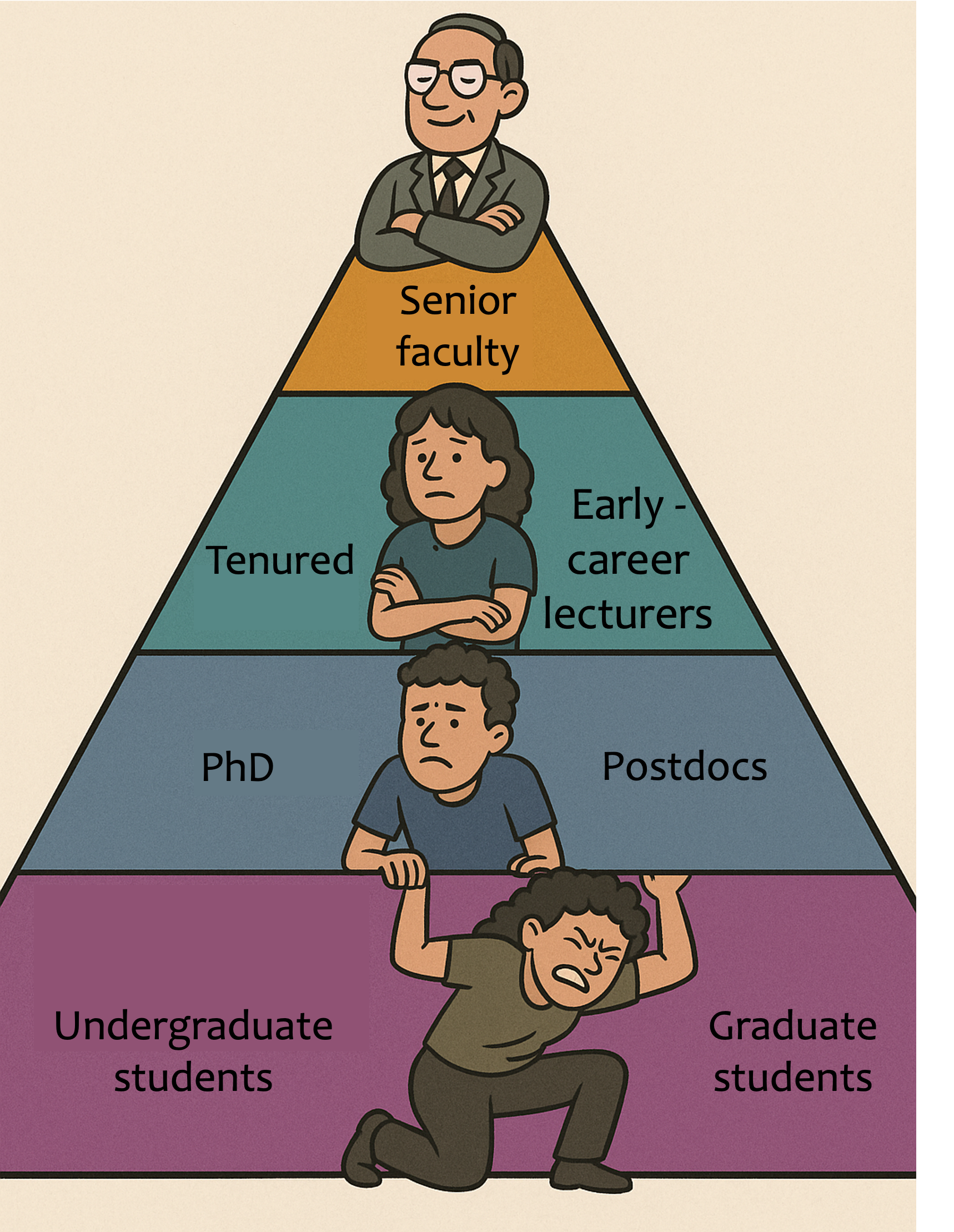
Academia is often seen as a place of knowledge, progress, and innovation. From the outside, it appears to be a noble environment, driven by curiosity and a desire to better understand the world. But once inside, many discover a very different reality. A reality shaped by rigid hierarchies, unspoken rules, and sometimes, a toxic work culture.
Few environments are as steeply hierarchical as academia. The path is well-defined: undergraduate students, graduate students, PhD candidates, postdoctoral researchers, early-career lecturers, and finally, tenured professors and senior faculty. At each level of the academic hierarchy, responsibilities grow, expectations rise, and the pressure intensifies, all in pursuit of that desired status.
There are practical reasons this structure exists. Learning environments rely on clear support and expertise: students need mentors, projects need direction, and institutions need strong leadership. Hierarchies in education help maintain order and define responsibilities, promoting discipline in research, accountability in mentoring, and structure in academic administration. But while hierarchy can serve a functional purpose, it often comes with hidden costs, particularly when it creates toxic social dynamics and disempowers those at the bottom of the ladder. This should not suggest that all academic institutions are toxic. There are many inspiring mentors and inclusive environments across the academic world. Still, these dynamics are undeniably widespread and often treated as a necessary part of the system.
One of the most striking issues is the strict separation between the different layers of the academic hierarchy. And it is not just about job titles, as it also manifests in the daily life and routine. It is surprisingly common, for example, for students or junior researchers to be restricted from using the same equipment, offices, or even tearooms as their superiors. These seemingly small rules reinforce a sense of exclusion that can lead to feelings of isolation and awkwardness in the workplace. And for those lower in the hierarchy, this isolation often breeds anxiety. You are unsure whether you are allowed to speak up, if you are even welcome to participate in conversations, and where you belong. Over time, this social discomfort can hinder communication, and we all know that poor communication does not just harm relationships, but it directly impacts the quality of work and collaboration.
More troubling is the pattern of dismissiveness by those in positions of authority, which in some cases, resembles bullying behaviour. It is not uncommon for undergraduate students to be treated as if they are unworthy of time or attention, and dismissed just because they know nothing. But of course, they do not…they are students! And that is the whole point of education: to guide, mentor, and develop the next generation of thinkers. This dismissiveness is not limited to students. Many early career researchers are made to feel like expendable labour, there to handle the tedious tasks, publish under someone else’s name, and remain silent in meetings.
And perhaps the most insidious part is how normalised this behaviour has become. After years of pressure, stress, and mistreatment, those who finally reach the top of the academic pyramid often end up perpetuating the very behaviours they once suffered. There is a harsh logic to it: “I went through this, so you should too.” It’s a toxic cycle that continues generation after generation, deeply internalised and rarely questioned. In many ways, this resembles a kind of institutional initiation: an endurance test masked as a rite of passage. It is almost democratic in its toxicity as nearly everyone is subjected to it, regardless of background or talent. The justification is that it builds resilience, but in reality, it simply normalises trauma and sustains unhealthy power dynamics.
However, change is possible. Hierarchy might be inevitable in structured learning environment, but that does not mean it has to be oppressive and toxic. Community-based approaches, where people are encouraged to connect, share ideas, and collaborate across status boundaries, often lead to more relaxed and productive environments. When people feel respected and seen, regardless of their title, they tend to be more open, more engaged, and more keen to contribute meaningfully because they feel a sense of belonging. Simply easing hierarchical boundaries can make a meaningful difference. Encouraging open-door policies, shared spaces, more informal mentoring, and genuine conversations across levels could help to build trust and break down unnecessary barriers.
If you have navigated the academic system, facing the pressure, silence, and sense of invisibility, remember that you have the power to break the cycle. You do not have to pass the same treatment down the line. It is possible to maintain structure and rigor while also building a culture of kindness, openness, and support. We owe it to ourselves and to the next generation of scholars, to create an academic environment that uplifts rather than oppresses, that teaches through empowerment rather than fear.
Let’s reimagine what academia could be: not a place of hierarchy for hierarchy’s sake, but a space of shared growth and human connection!
This is why I decided not to pursue academia, despite of being into research. Even within Medicine, there is so much hierarchy, and blind reverence for those with 'Consultant' status. It is inherently patriarchal, and assumes that anyone who isn't at the top is stupid.
On a larger scale, this applies to the real world where knowledge is kept in the hands of a few (institutions, governments, police, doctors) with power, and the common public is treated as idiots. This strips them of their autonomy.
I actually think people who are not so rigid, students, and citizen scientists are able to think in an out-of-the-box manner which promotes real Science.
It's weird because I wasn't treated great as an undergrad, then started grad school and the faculty were like the undergrads need to be catered to, since they are paying customers (not sure how that panned out) and you're an employee!